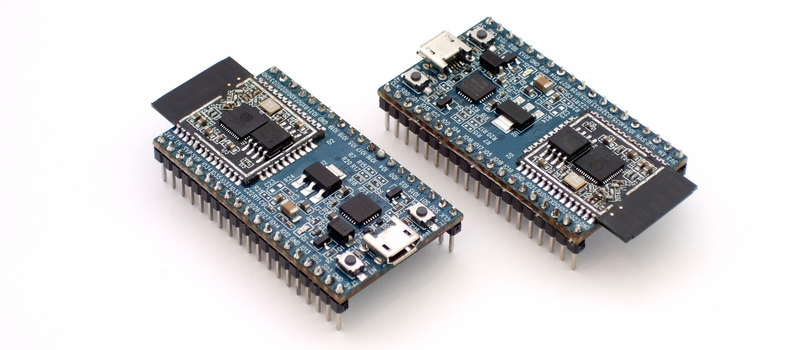
New board

After the ESP8266, the ESP32

After the success of the ESP8266, Espressif has developed a brand new device called the ESP32, which is much more powerful and supports dual WiFi and Bluetooth connections.

There are some dev kits ready for its use, and the Espressif team is working on adding support for the Arduino IDE on their GitHub page.

The chip

Some specs of these boards

A dual core microcontroller with integrated Wi-Fi and dual mode Bluetooth, sensors, 32 GPIO and hardware accelerated encryption.

240 MHz
dual core Tensilica LX6 microcontroller
600 DMIPS
520 KB
integrated SRAM
135 Mbps
UDP sustained throughput
2.5 μA
deep sleep current
Espressif ESP32 specifications
GroupSpecifications
Key Features
  • 240 MHz dual core Tensilica LX6 microcontroller with 600 DMIPS
  • Integrated 520 KB SRAM
  • Integrated 802.11BGN HT40 Wi-Fi transceiver, baseband, stack and LWIP
  • Integrated dual mode Bluetooth (classic and BLE)
  • 16 MByte flash
  • 2.2V to 3.6V operating voltage
  • -40°C to +125°C operating temperature
  • On-board PCB antenna / IPEX connector for external antenna
Sensors
  • Ultra-low noise analog amplifier
  • Hall sensor
  • 10x capacitive touch interface
  • 32 kHz crystal oscillator
32x GPIO
  • 3 x UARTs, including hardware flow control
  • 3 x SPI
  • 2 x I2S
  • 12 x ADC input channels
  • 2 x DAC
  • 2 x I2C
  • PWM/timer input/output available on every GPIO pin
  • OpenOCD debug interface with 32 kB TRAX buffer
  • SDIO master/slave 50 MHz
  • Supports external SPI flash up to 16 MB
  • SD-card interface support
Security Related
  • WEP, WPA/WPA2 PSK/Enterprise
  • Hardware accelerated encryption: AES / SHA2 / Elliptical Curve Cryptography / RSA-4096
Performance
  • Supports sniffer, station, softAP and Wi-Fi direct modes
  • Max data rate of 150 Mbps@11n HT40, 72 Mbps@11n HT20, 54 Mbps@11g, and 11 Mbps@11b
  • Maximum transmit power of 19.5 dBm@11b, 16.5 dBm@11g, 15.5 dBm@11n
  • Minimum receiver sensitivity of -98 dBm
  • 135 Mbps UDP sustained throughput
  • 2.5 μA deep sleep current

Thinger.io support

Connect the ESP32 from the Arduino IDE

You can update the Thinger.io libraries directly from the Arduino IDE, where a new ESP32 example will appear.

Thinger.io console dashboard titled ESP32 Dashboard: tiles for transmitted data, received data, IP address and an Online device state, the time connected, and a live transmission chart
An ESP32 connected to the platform: its dashboard shows the device online, the data transmitted and received, and the time connected.

Today the ESP32 is one of the boards of the Thinger.io Arduino client, and a native ESP-IDF client targets the ESP32, ESP32-S3 and ESP32-C3. Both are on Device connectivity, and the protocol they speak is IOTMP.

Put your ESP32 online

The Thinger.io documentation walks through connecting an Espressif ESP32 with the Arduino library.