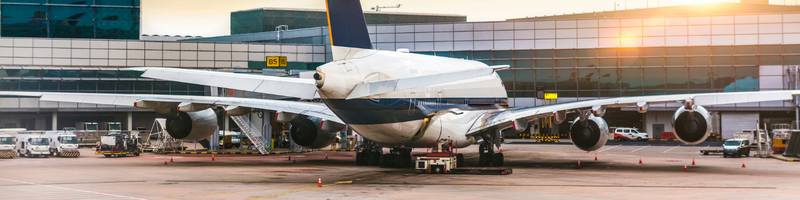

Smart airports
Robots that run on AI and IoT are reaching the terminal
A study conducted by Market Research Future (MRFR) has revealed that the airport robot industry is estimated to expand exponentially between 2021 and 2027, with an annual growth rate of 16.8%.
Robots that work thanks to AI and IoT turn airports into smart airports: they rely on intelligent systems, such as sensors and devices configured for specific purposes in different areas, to control, manage and plan the airport's operation in a centralized digital environment.
The latest advancements include robots handling check-in procedures, performing security checks, cleaning, and even delivering food to passengers.
Already in service
Four airports where robots already work
This solution can already be seen in different airports around the world.
Philadelphia
Kansai
Hamad
Heathrow
Philadelphia
Gita, the robot that brings the food order
PHL Food and Shops recently welcomed a new addition to their team at Philadelphia International Airport: a robot named Gita.
Gita at a glance
- Robot
- Gita
- Operator
- PHL Food and Shops
- Height
- 26 inches
- Payload
- Up to 18 kg
- On a single charge
- Up to four hours, equivalent to 20 miles of walking
- Task
- Delivering food orders to passengers in airport lounges
Gita uses human-like manners as it moves through busy and crowded areas. It is worth noting that PHL Food and Shops already had a contactless ordering system in place, so customers could place food orders with ease.
Kansai
Security patrols by Secom robots
Not intended for high-speed pursuits, these robots are equipped with various features that can alert security in case of a breach.

The Secom robot
- Designed by
- Secom, Japanese security company
- Size
- 123 cm high, 84 cm wide
- Weight
- Approximately 230 kg
- Maximum speed
- 4 km/h
- Operating time
- Around 3 hours
- Navigation
- 100% autonomous, on pre-mapped routes
- Sensors
- Laser sensor360-degree cameraUltrasonic sensorBumper sensor
- Warnings
- Warning functionsWarning lampWarning voice
The built-in laser sensor lets the robot determine its location and navigate the airport terminal on its own. As it patrols its pre-mapped routes, it captures images of passengers and surroundings with its cameras.
Junichi Takahashi, Manager at the Kansai Airports Operation Centre, explains that the robot navigates while avoiding collisions with passengers and facilities using its motion sensors. Once its patrol is complete, the robot stops at its designated position and continues to monitor the area.
Hamad
A security robot in the form of a scooter
Hamad International Airport in Qatar has adopted a scooter-shaped security robot.
To maintain security, its multiple cameras can:
- monitor pulse rates;
- perform face recognition;
- detect counterfeit credit cards and currencies.
It also uses an algorithm to assess a passenger's mood: by detecting elevated body temperature, heart rate and stress levels, it identifies whether a passenger is nervous or upset.
Heathrow
Cleaning terminals and lounges with UV light
At Heathrow Airport, cleaning robots equipped with UV light technology disinfect surfaces to keep a sanitary environment for travelers.
UV light is known to effectively eliminate viruses and bacteria, keeping passengers in a safe and secure environment.
These robots have the ability to eliminate up to 99.9% of harmful pathogens by thoroughly cleaning any surface that may contain viruses or bacteria.
The highly efficient UV-C light the robots use can cover an area of 18,000 square meters in just two and a half hours.
Outlook
This is only the beginning
Different types of robots are already operating in different airports around the world, yet few airport organizations say they are very prepared for IoT.
- 12%
- of airport representatives say their organizations are very prepared to benefit from IoT
- Deloitte survey
- 10%
- felt they were not even exploring IoT yet
- Deloitte survey
A survey by Deloitte revealed that only 12 percent of airport representatives reported that their organizations are very prepared to benefit from IoT applications. The same study declares that another 10 percent felt they were not even exploring IoT yet.
Thinger.io can help bring companies and the Internet of Things together, with a cloud IoT platform that operates without touching any type of code.
Have an idea you could develop further with IoT?
If you have an idea you think you can develop further with IoT but do not know how, arrange a meeting with one of the team's experts.