

Case study
Every fuel transfer accounted for, from refinery to pump
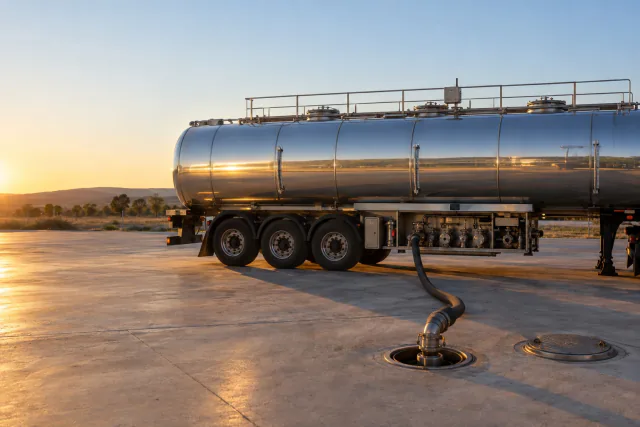
A fuel distribution operation that meters both ends of every transfer: level sensors on tanker trucks and stationary tanks feed a live volume differential, so the product that leaves a refinery arrives where the contract says it should.
- Sensors on trucks and tanks
- Live volume differential
- Alerts on discordance
- Contract-checked operations
- Client
- Fuel distributor
- Sector
- Fuel distribution
- Connectivity
- Internet and GPS
- Hardware
- Level sensors, GPS
The context
Where the fuel goes missing
When energy prices spiked, fuel theft spiked with them. Industry estimates put global losses at around $133 billion, and most of that fuel goes missing during product transfers, in the gap between what leaves one tank and what arrives at the next.
This project digitalizes the transfer itself, monitoring from several fronts at once and handling all of that data in real time.
The operation
Fuel distribution, end to end
- The chain
- RefineriesIntermediate depotsService stations
- Where fuel goes missing
- During transfers, between two meters
- Measured
- Tank levelsTruck levelsGPS position
- Benchmark
- The volumes contracted with suppliers and customers
The solution
Both ends of every transfer, metered
The monitoring infrastructure connects level sensors to the tanker trucks and to the stationary tanks, and computes the differential of the volume transferred between them in real time. The sheet below redraws the views this produces: what leaves the truck, what enters the tank, the live difference between the two and the record of every operation.
Tanker truck level
FIG. 01Level sensors on each tanker truck read the volume on board live, so the drop during a discharge is measured, not declared.
LEVEL TO VOLUME ON BOARD · DISCHARGE PROFILE · GPS POSITION
Stationary tank level
FIG. 02The stationary tanks at intermediate depots and service stations carry the same level sensing, so the receiving side of every transfer is metered too.
TANK LEVEL · MAX / MIN THRESHOLDS · RECEPTION PROFILE
Live transfer differential
FIG. 03Both level streams merge into one differential: dispatched volume against received volume, computed in real time while the transfer runs.
DISPATCHED VS RECEIVED · REAL TIME Δ · DISCORDANCE ALERTS
Operations against contract
FIG. 04Each operation goes on record with its differential, supervised against the volumes contractually established with suppliers and customers.
OPERATION LOG · SOURCE / DESTINATION · CONTRACT SUPERVISION
Results
What it changes for the operation
Losses stop being an end-of-month inventory surprise. The infrastructure merges tank and truck data, checks the volumes in real time and raises an alert on any discordance while the transfer is still under way.
Fewer unexplained losses, and a traceable record behind every litre moved.
For the operation
Every transfer, accounted for
A discordance
Before: Found at month endNow: Alerted during the transfer
Each delivery
Checked against the contracted volumes
Every operation
Recorded end to end, with the full history kept for analysis
Traceable
Under the hood
How it runs on Thinger.io
The monitoring runs on Thinger.io, which handles the level sensors on trucks and tanks as managed devices and merges both streams in real time. It stores and analyzes historical and live data and serves it back through dashboards with map display, so operations teams follow every truck and tank from one console.
Position comes from any internet-connected GPS tracker, and geoperimetry adds entry and exit alerts around depots and stations.
Keep reading
More success stories

Arvum: agronomy know-how delivered as a service
Growers irrigate by soil profile data, guided through AG-ZOOM, the firm's own platform.
Read the case study
MAPHI: fresh food grown in Antarctica
A hydroponic module at Marambio Base grows fresh greens at -30 °C outside.
Read the case study
UPM and UC3M: hydrology measured sensor by sensor
A dense NB-IoT network of soil moisture probes and water level gauges across two catchments.
Read the case studyNext step
Meter both ends of your operation
This infrastructure is one industrial deployment of Thinger.io. If you move fuel, water or any product where what leaves must match what arrives, we can help you measure it in real time.