

Case study
MAPHI: fresh food grown in Antarctica
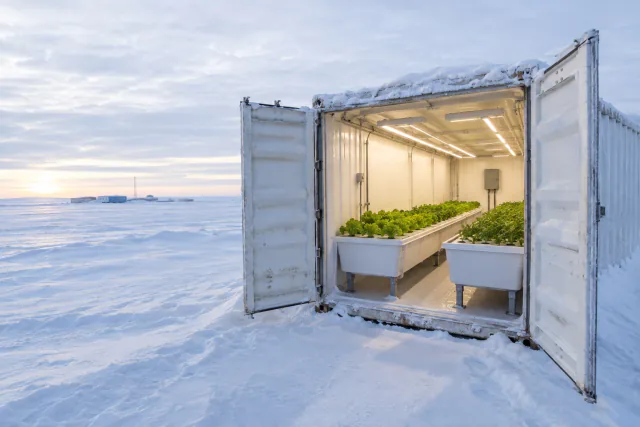
A hydroponic module at Argentina's Marambio Base grows up to 240 plants per cycle inside a 20-foot container, so the crew of one of the most isolated outposts on Earth eats greens harvested metres from the canteen.
- Fresh greens for the base crew
- Up to 240 plants per cycle
- Five variables under watch
- Run from thousands of km away
- Client
- MAPHI, INTA and UNPA
- Sector
- Hydroponics
- Location
- Marambio Base, Antarctica
- Hardware
- Climate and water sensors
Who they are
A farm run by scientists
MAPHI, the Antarctic Hydroponic Production Module, is the work of INTA, Argentina's National Institute of Agricultural Technology, with UNPA and the Argentine Antarctic institutions. Their brief: produce vegetables year-round at Marambio Base, where winter reaches -30 C.
Their answer fits in a 20-foot container, where a few degrees too cold or a drift in pH can cost the entire crop.
The module
MAPHI at Marambio Base
- Site
- Marambio Base, Argentina's permanent scientific outpost in Antarctica
- Module
- A 20-foot container with a fully controlled indoor environment
- Method
- Deep Water Culture rafts, roots in nutrient solution instead of soil
- Capacity
- Up to 240 plants per cycle
- Measured
- TemperatureHumidityWater levelpHConductivity
The module
What the team keeps in range
Growing at Marambio is a control problem before it is a farming problem. Each variable has an optimal range, and the team's job is keeping every one of them inside it, every hour of every day, with the outside air trying its best to argue. The sheet below redraws what they watch.
Two climates, one wall apart
FIG. 01A flat growing climate held inside the shell while the Antarctic winter runs to -30 C on the other side of the wall.
INTERIOR TEMP · EXTERIOR TEMP · WINTER LOWS -30 C
Water chemistry
FIG. 02The pH and electrical conductivity of the nutrient solution, each held inside its target band. A drift in either can affect the entire crop.
WATER pH · ELECTRICAL CONDUCTIVITY · TARGET BANDS
Nutrient reservoir level
FIG. 03The water level in the reservoir feeding the rafts, with its refill threshold marked. A low level raises an alert before the crop notices.
WATER LEVEL · REFILL THRESHOLD · LOW LEVEL ALERT
Air inside the module
FIG. 04Relative humidity held in its band while air keeps moving through the growing chamber, in a sealed box the weather never enters.
RELATIVE HUMIDITY · AIR CIRCULATION · SEALED CHAMBER
From seed to harvest
FIG. 05Deep Water Culture rafts hold up to 240 plant sites per cycle, followed from seeding through growth to harvest day.
DWC RAFTS · UP TO 240 PLANTS / CYCLE · SEED / GROW / HARVEST
The moment a variable escapes
FIG. 06When any variable leaves its optimal range, an automated alert reaches the team on the spot, wherever on the planet they happen to be.
AUTOMATED ALERTS · OPTIMAL RANGES · PUSH TO THE TEAM
Results
Fresh food on Antarctic plates
The measure of success is served in the base canteen: lettuce and arugula grown metres from where they are eaten.
The project also proves a wider point. If a crop can run automated at -30 C, with the nearest specialist thousands of kilometres away, it can run automated on any farm.
First harvest
Grown and eaten at Marambio
Harvest for the base crew
Outside the module
Down to -30 C in winter
Operation
Supervised and run remotely, thousands of kilometres away
Remote
Harvest figures as reported by the MAPHI project.
Under the hood
How MAPHI stays in range
Every sensor in the container streams to Thinger.io: temperature, humidity, water level, pH and electrical conductivity arrive as live telemetry for real-time analysis. Dashboards show the state of the module at a glance, and the moment any variable falls outside its optimal range the platform raises an automated alert.
The same link carries control the other way. The team supervises and operates the module remotely, from thousands of kilometres away, which keeps manual intervention to a minimum. On an outpost where every hand has other work, the farm mostly runs itself.
Keep reading
More success stories

Arvum: agronomy know-how delivered as a service
Growers irrigate by soil profile data, guided through AG-ZOOM, the firm's own platform.
Read the case study
UPM and UC3M: hydrology measured sensor by sensor
A dense NB-IoT network of soil moisture probes and water level gauges across two catchments.
Read the case study
SeaWater Analytics: a live quality index for bathing water
Smart buoys over submarine outfalls feed a beach water quality app on the Xàbia coast.
Read the case studyNext step
Automate your growing environment
MAPHI runs its Antarctic crop on Thinger.io. If your greenhouse, vertical farm or growing module needs the same kind of watchfulness, we can help you get there.