

Case study
Clean office air, from a purifier fleet that reports its own state
A smart building deployment where air purification units across office buildings monitor themselves, so the teams that maintain them act on real condition and the people working below them just breathe clean air.
- Ionization and filtering
- Status on every unit
- Alerts on anomaly
- Service on condition
- Client
- Purifier fleet operator
- Sector
- Air purification
- Scope
- Office buildings
- Hardware
- Connected air purifiers
The context
Clean air becomes office infrastructure
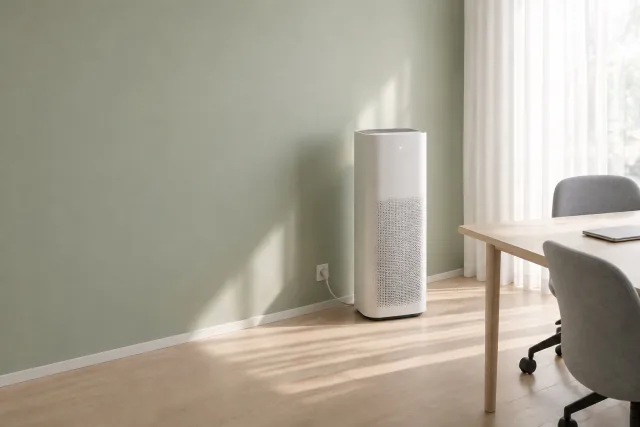
Air quality has become a closely watched variable, and offices are judged by it. Companies now deploy autonomous purification systems that reduce the microorganisms in the air people share.
Their ionization and filtering stages need periodic maintenance, and how often depends on where each unit sits. Across every unit in every building, that becomes a long-term logistics problem, the one this deployment set out to solve.
The equipment
Air purification units
- Stages
- IonizationFiltering
- Service interval
- Set by the environment each unit sits in
- Same unit, different wear
- A busy lobby ages it faster than a quiet meeting room
- Scale
- Many units per building, across every building in the deployment
The monitoring
What the fleet reports
Every purification unit becomes a connected device that reports its own condition. The sheet below redraws, as stylized figures, the monitoring the deployment runs on: the state of each purifier, the wear of its filters, the air quality record behind it and the distributed fleet as a whole.
The purifier, reporting in
FIG. 01Each unit reports whether it is running, the ionization and filter stages it relies on, and every event in its log. An anomaly becomes a notification the moment it is detected.
STATE · ION + FILTER STAGES · EVENT LOG
Same filters, different environments
FIG. 02Filter wear is tracked unit by unit. Filters installed the same day age at different speeds depending on the environment, so service goes where the wear says, not where the calendar guesses.
FILTER WEAR PER UNIT · INTERVAL SET BY THE ENVIRONMENT
The record behind each unit
FIG. 03The record behind each unit: load builds as the environment demands, crosses the attention level, and the service that follows shows up on the same curve, in real time and over the long term.
REAL TIME + LONG TERM · EVENTS OVERLAID ON THE CURVE
Every building, at a glance
FIG. 04The whole fleet on one screen: every unit in every building, green while healthy and flagged the moment something needs attention, with no technician on site.
FLEET VIEW · STATUS PER UNIT · ALERTS ON EVENT
Results
Maintenance moves from calendar to condition
For the people in the offices, the result is simply air that stays clean. For the teams running the fleet, monitoring is on automatic pilot, and the deployment keeps growing building by building.
For the fleet
Maintenance by condition
Servicing
Before: Fixed scheduleNow: When the unit's condition asks
An anomaly
Before: Found on the next visitNow: A notification
Each unit
Status verified in real time and over the long term
Monitored
Growth
Before: More eyesNow: More devices
Under the hood
The platform behind the fleet
The deployment runs on Thinger.io. Every purifier is a managed device on the platform, so extending the fleet to a new floor or building means provisioning devices, not building software.
On top of that layer, the platform notifies on any anomaly and provides the data visualization to verify each unit's status, in real time and across the long term.
Keep reading
More success stories

Office space utilization, measured room by room
Anonymized occupancy sensing turns how an office is really used into action plans.
Read the case study
Arvum: agronomy know-how delivered as a service
Growers irrigate by soil profile data, guided through AG-ZOOM, the firm's own platform.
Read the case study
MAPHI: fresh food grown in Antarctica
A hydroponic module at Marambio Base grows fresh greens at -30 °C outside.
Read the case studyNext step
Put your device fleet on automatic pilot
This deployment is one way to run a distributed fleet on Thinger.io. If your equipment ships in large numbers and needs to be watched, serviced and scaled, we can help you build the platform behind it.